About Hawaii Tropical Botanical Garden Tour Hawaii Tropical Botanical Garden Flower Bouquets Education at Hawaii Tropical Botanical Garden Get Married at Hawaii Tropical Botanical Garden Group events at Hawaii Tropical Botanical Garden Memberships at Hawaii Tropical Botanical Garden Hawaii Tropical Botanical Garden About Hawaii Tropical Botanical Garden

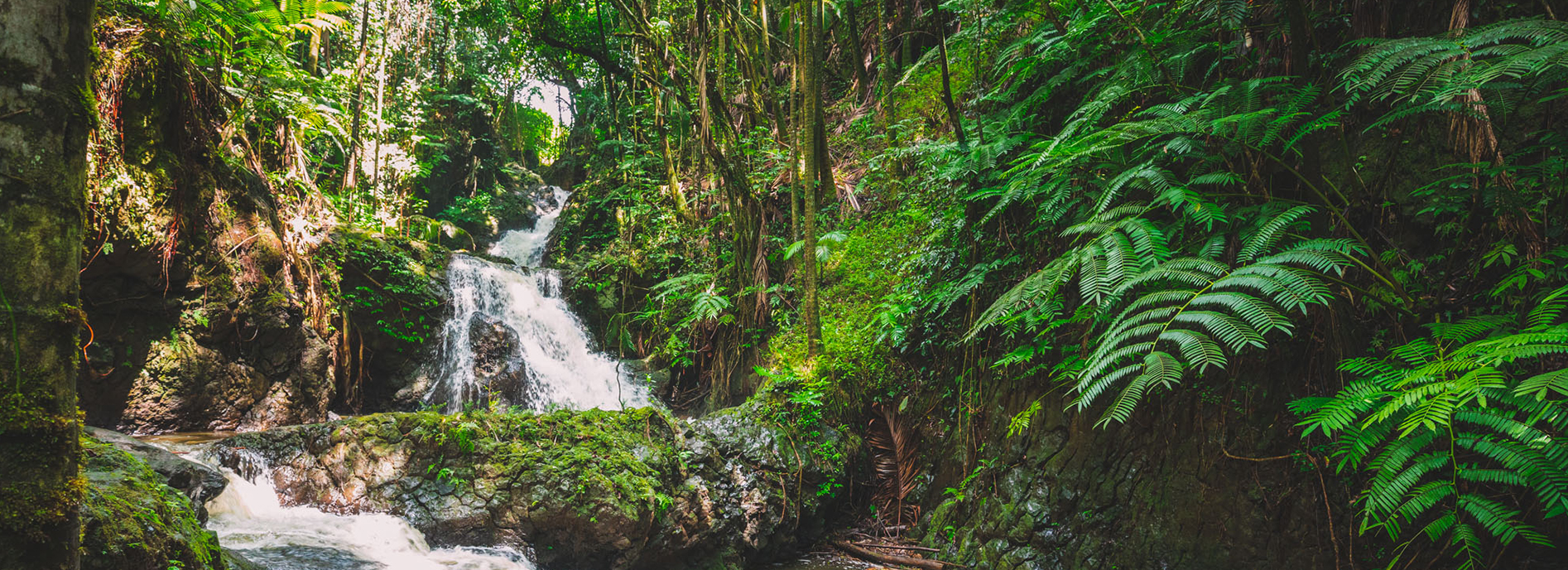
Lily LakeAloha and welcome to Onomea Bay and the Hawaii Tropical Botanical Garden! This "garden in a valley on the ocean" is located off of Highway 19 on the lush Hamakua Coast, 8 1/2 miles north of Hilo in the sheltered Onomea Valley on the Big Island of Hawaii.. In Hawaii, onomea means "the best place." And indeed, no better place exists.
 
The Hawaii Tropical Botanical Garden is a museum of living plants that attracts photographers, gardeners, botanists, scientists, and nature lovers from around the world. The Garden's collection of tropical plants is international in scope. Over 2,000 species, representing more than 125 families and 750 genera, are found in this one-of-a-kind garden. The 40-acre valley is a natural greenhouse, protected from buffeting tradewinds and blessed with fertile volcanic soil. Some of the Garden's enormous mango and coconut palm trees are over 100 years old. Tropical plants that struggle to grow in homes and gardens across America reach gigantic proportions here.

The Hawaii Tropical Botanical Garden's mission is to serve as a nature preserve and sanctuary. The Garden is dedicated to the collection and display of the world's tropical plants, and to the education of both children and adults about the plight of the world's rainforests. At a time when rainforest plants are disappearing at an alarming rate, the Garden is working to preserve as many species as possible for the benefit of future generations.

The Vision of Dan Lutkenhouse

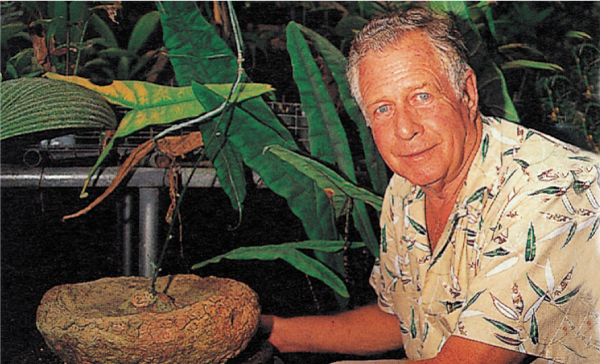
Dan and Pauline LutkenhouseThe Garden was created through the untiring efforts of one man, Dan J. Lutkenhouse, who discovered Onomea Valley in 1977 while vacationing with his wife, Pauline. Mr. Lutkenhouse purchased the 17-acre parcel for its seclusion and beauty, without knowing exactly what to do with it. Quickly abandoning ideas for a commercial venture which would destroy the natural environment, he decided instead to establish a botanical garden to preserve the valley and its beauty forever.
 
When first located by the Lutkenhouses, Onomea Valley was an overgrown and virtually impenetrable jungle, choked with wild invasive trees, weed and thorn

thickets, and strangling vines.Mr. Lutkenhouse sold his 40-year-old trucking business in San Francisco and moved to the island of Hawaii in order to devote himself full time to the development of the Garden.

Every day for eight years, Pauline would pack Dan a brown bag lunch and he would disappear into the jungle, returning at night dirty and tired, but happy. During that time Dan, his assistant Terry Takiue, and two helpers worked with cane knives, sickles, picks, shovels, and a chain saw clearing paths through the jungle. All the work was done by hand to avoid disturbing the natural environment or destroying valuable plants and tree roots. The men kept a slow and easy pace, so as not to suffer heat stroke or dehydration in the steamy jungle. The work would continue seven days a week until the Garden opened to the public in 1984.

Trails were hewn from hard lava rock with picks and shovels. To keep the soil from compacting and the natural beauty from being destroyed, no tractors were used; excess rock was removed and gravel brought in by wheelbarrow. Mr. Lutkenhouse followed the contours of the land in designing the Garden trails, which curve and wind their way throughout the jungle. Gradually, secret landscapes revealed themselves. It took years of carefully clearing the jungle before Mr. Lutkenhouse discovered the crown jewel of the Garden - a three-tiered waterfall said to be the most beautiful in all Hawaii.

Though Mr. Lutkenhouse has no formal botanical training, with his love of nature he has created a living tapestry in keeping with the intimate nature of the site. Subtle vistas unfold as you meander along the Garden paths. Patterned foliage and brilliantly colored flowers invite close inspection, enticing you further into the mysteries of the jungle. This is the allure of paradise. The Hawaiians have a word for it - aina, or "the spirit of the land."

Mr. Lutkenhouse, himself, has chosen the location of every plant and tree introduced to the Garden. From the Lily Lake Vista, more species of plants can be seen in one place than anywhere else on earth. Over 110 species have been counted within this vista, most planted by Mr. Lutkenhouse and his staff. This vivid experience of the tropics has been enriched by the plant collecting trips Dan and Pauline Lutkenhouse have taken to tropical jungles around the world.

Preserving the Spirit of the Land

To protect the Garden site, Dan and Pauline Lutkenhouse have established a non-profit 501 (c)(3) corporation and have taken legal steps to insure the land will never be sold or commercially developed. Dan is adamant on this point. "It's too precious a valley to be developed. We're preserving the valley so that mankind can enjoy it forever." He adds, "I believe that we should all try to leave the world a better place than we found it."

From a diamond in the rough, the Hawaii Tropical Botanical Garden is being polished to perfection. While the star of the show is the Garden itself, its creation and success are attributed to more than 17 years of hard work and dedication, as well as the prior business experience of Dan and Pauline. Today the Garden has 17 full-time employees and is financially self-supporting. Dan and Pauline gain no financial rewards from the Garden; instead, they have contributed more than $2 million of their own personal funds to establish it. Their reward is the true enjoyment the Garden provides to its visitors. Dan and Pauline's vision of preserving rare tropical plants in one of Hawaii's most beautiful natural settings has been shared by more than 700,000 visitors to date. In the year 1995, they donated the land to HTBG.

The Lutkenhouses have listened to the land and its creator, and allowed the aina to guide them. Under their protection, the spectacular flora and fauna of Onomea Bay are flourishing as a world-class botanical garden, described by many as the most beautiful accessible tropical jungle garden in the world. Truly the Garden is a perfect expression of the state motto of Hawaii, ua mau ke ea o ka aina i ka pono, or "the life of the land is perpetuated in righteousness."

Onomea Bay: A Geological and Human History
E ola mau, e Pele e!
`Eli'eli kau mai!
Long life to you, Pele!
-Hawaiian Goddess of Volcanoes

The Hawaiian Islands are actually a chain of volcanic mountains, described by Mark Twain as "the loveliest fleet of islands to sail in any ocean." Twain was more than flattering in his analogy; he was also scientifically correct. The Hawaiian Islands are slowly moving through the Pacific Ocean in a northwesterly direction, the result of a phenomenon known as plate tectonics.

Hawaii Volcano Lava FlowGeologists have determined that the Hawaiian Islands lie on the upper crust of the Pacific continental plate. The plate is the size of half the North Pacific Ocean, and it literally floats on the heavier magma of the earth's core. A crack in the continental plate leaks lava to the upper surface. This is the "hot spot" that has created the entire Hawaiian archipelago. Lava pours out of the ocean floor and piles up as hardened magma until the newly formed land reaches above sea level.

Today "hot spots" still smoke on the Big Island of Hawaii, the youngest island in the chain, just as they did millions of years ago. The Kilauea Volcano in Hawaii Volcanoes National Park is very active; molten lava flows down to the ocean, creating more new land on the island of Hawaii. The next Hawaiian island, named Loihi, is a mountain of fresh lava slowly growing on the sea floor southeast of the Big Island. In several thousand years it will rise above the ocean surface, and another Hawaiian island will be added to the chain.

The Shaping of Onomea Bay

Over the millennia, erosion has been one of the primary forces shaping Onomea Bay. Onomea and Alakahi streams have carved the valley, while winds and waves have cut the lava cliffs. Earthquakes and tsunamis have rocked the coast, causing radical changes in the face of the landscape.

The most notable work of the elements was Onomea Arch, carved from the cliffs by restless waterpower. Legend has it that King Kamehameha threw his spear to create this huge tunnel in the rock. A famous landmark, the arch attracted visitors to Onomea Bay long before the Garden was established.
 
Onomea Arch fell during an earthquake in 1956 after standing for thousands of years. Today the fallen arch appears as a wide crevice in the cliff on the north side of Onomea Bay, but this favorite Hilo landmark is preserved in antique postcards which recall its glory from the turn of the century.

The Bay's Early History

Long ago, Onomea Bay was a fishing village for the early Hawaiians. Old stone walls in the Garden today were created by early settlers to make terraces for growing taro and sugar cane.These stone walls kept the land on the slope from eroding into the stream.
 
Onomea Bay served as one of the Big Island's first natural landing areas for sailing ships. In the early 1800s the fishing village, known as Kahali'i, became a shipping port, first importing materials to construct the Onomea Sugar Mill and then exporting raw sugar. The settlers were a mixture of Portuguese, Chinese, Japanese, and Filipinos who came here to work in the sugar cane fields and build the Onomea Sugar Mill.


In the hills above the Garden are relics of the Onomea Sugar Mill. Rusty iron trestles and flumes once stood where hand-cut cane was floated to the mill. Sacks of unrefined sugar were then loaded on donkeys and taken down a trail to the docks.
 
Another remnant of this era is a Portuguese bake oven, discovered on Cook Pine Trail when the jungle was being cleared. Made of heat resistant rocks, the igloo-like structure was used to bake bread on a flat shovel.

After the Onomea Sugar Mill ceased operations, the early settlers gradually moved away. Later, part of the valley was a lilikoi, or passionfruit farm. Some cattle were grazed in the valley as well. A row of stately old palms that lines the narrow scenic route was planted by the plantation supervisor from the Onomea Sugar Mill. Wild banana, mango, coconut, and guava trees planted by the early settlers have reached towering heights and still grow here today.

Onomea Valley was deserted in the early 1900s, and the vegetation grew so densely that few signs of former habitation could be seen. The last resident of the valley was Lono Waikii. Legend has it that Lono's wife would get angry at his all-day fishing and drinking adventures and hide his whiskey bottles in a banyan tree. The tree grew up around the bottles, where they can still be seen today.

In Harmony with Nature

The early settlers removed all of the valley's native vegetation. There remained only some tall coconut palms, which now are over 150 years old. The tall mango and monkeypod trees in the valley today have grown up since 1850.

Dan and Pauline Lutkenhouse have transformed Onomea Valley from a dense jungle to a pristine tropical paradise. Plant specimens have been gathered from tropical jungles around the world and planted by hand. The entire valley is treated as a nature preserve. To protect the environment, no cars or tour buses are allowed in the valley.

Visitors marvel at the giant rainforest trees that form the dense overstory canopy of Onomea Valley. These include 100-foot tall mango trees that were probably planted in the late 1800s; breadfruit trees that date from the early 1900s, with their huge, speckled green fruit; and towering coconut palms that are constantly pruned to protect visitors from falling fruit. Low-growing taro plants can also be seen, carryovers from village life at the turn of the century when starchy poi, made from taro roots, was a staple of the Hawaiian diet.

In the Hawaii Tropical Botanical Garden, exotic plants gathered from distant tropical rainforests grow side by side with native Hawaiian plants. Together they form a spectacular living work of art in the only tropical botanical garden in the United States that is situated on an ocean coast.


[ Virtual Tour Of Gardens ][ About HTBG] [ Purchase Flowers On Line ]


HAWAII TROPICAL BOTANICAL GARDEN
27-717 Old Mamalahoa Highway
P.O. Box 80, Papaikou, HI 96781
Phone: 808-964-5233 FAX: 808-964-1338
E-Mail